

The next big revolution in electric mobility is not faster charging, cheaper batteries, or longer range — it’s earning money from your car.
Vehicle-to-Grid (V2G) technology will turn EVs from simple transportation tools into mobile energy assets that support homes, businesses, and national power grids.
By 2026–2030, V2G is expected to transform EVs into mini power plants on wheels, enabling owners to profit from selling stored energy during peak demand.
1. What Is V2G and Why Does It Matter?
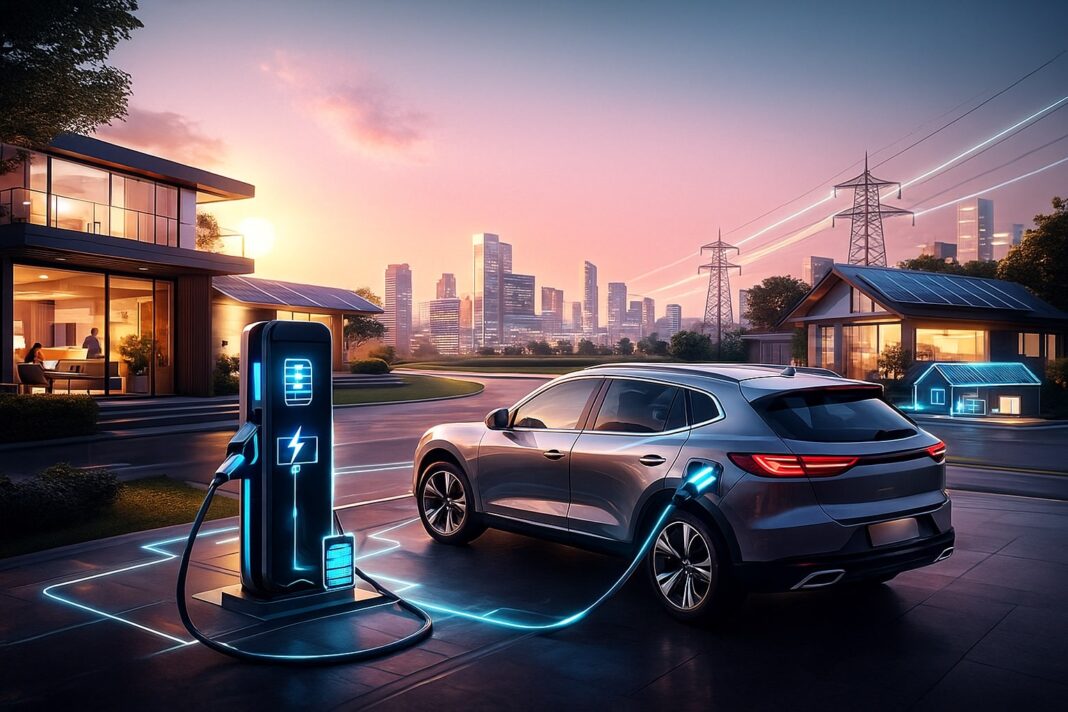
V2G (Vehicle-to-Grid) is a bi-directional charging system where EVs can:
- Take power from the grid (charging)
- Send power back to the grid (discharging)
Why it’s revolutionary:
- EVs are parked 95% of the time
- A single EV battery can power a home for 2–3 days
- Millions of EVs = massive distributed energy storage
- Utilities get grid stability
- Owners get monthly income
V2G turns EVs into active participants in the power economy.
2. How V2G Helps EV Owners Earn Money
Your EV can automatically sell stored energy when electricity prices are high.
Ways EV owners earn:
-
Selling electricity to the grid during peak hours
-
Providing backup power during outages
-
Supporting frequency regulation services
-
Participating in energy trading markets
In some pilot programs:
-
EV owners earn ₹1,500–₹4,000 per month
-
Fleet owners (delivery vans, taxis) earn 10× more
This becomes a new revenue stream — passive and continuous.
3. How V2G Works Technically
Key components:
-
Bi-directional EV charger
-
Smart meter
-
Cloud-connected energy management platform
-
Utility grid integration
Simple workflow:
-
EV plugs into a V2G-enabled charger
-
Cloud AI determines when to charge/discharge
-
Energy is sold back during peak demand
-
Payments are credited to the owner
The process is automatic — no user action required.
4. Why 2026–2030 Will Be the V2G Breakout Era
1. Global V2G regulations coming into effect
USA, EU, Japan, Australia, and UAE are approving bi-directional chargers.
2. Automakers adopting V2G as standard
Nissan, Ford, Hyundai, Kia, VW, BYD already support it.
3. Growth of renewable energy
More wind & solar = greater need for energy storage → EVs fill the gap.
4. Smart grids becoming mainstream
Grid operators want distributed storage for stability.
5. Falling cost of bi-directional chargers
New 2026 models will be 50% cheaper.
V2G is not a concept anymore — it’s an inevitable global upgrade.
5. Real-World Applications of V2G
✔ Home Backup Power (V2H)
Run your home using your EV during outages.
✔ Powering Buildings (V2B)
Offices use fleet EVs to reduce electricity bills.
✔ Selling Stored Energy (V2G)
EVs stabilise the grid and get paid.
✔ Microgrid Support
EVs help rural grids, solar farms, and remote zones.
✔ Emergency Disaster Relief
EVs supply energy to hospitals, shelters, and communication systems.
6. V2G’s Impact on the Energy Economy
A. Reduces electricity costs for everyone
Peak load reduction stabilizes prices.
B. Helps grids avoid blackouts
Energy stored in EVs is released back as needed.
C. Supports renewable energy expansion
Excess solar/wind energy stored in EVs is used later.
D. Turns millions of EVs into decentralized power plants
No big power plants needed — EVs become the storage.
7. Challenges V2G Must Overcome
-
Battery degradation concerns (now mostly solved)
-
Standardization of connectors
-
Utility regulation delays
-
High initial charger cost
-
Software integration across manufacturers
Despite these issues, governments are pushing V2G harder than ever.
8. How Much Can EV Owners Earn?
A typical EV participating in V2G earns:
| EV Use Case | Monthly Earnings |
|---|---|
| Home user | ₹1,500–₹4,000 |
| Office commuter | ₹3,000–₹7,000 |
| Taxi / ride-sharing EV | ₹8,000–₹15,000 |
| Delivery fleet | ₹12,000–₹20,000 per vehicle |
As energy prices increase, earnings will grow even more.
Conclusion
Vehicle-to-Grid is poised to become the biggest game-changer in EV history.
It transforms electric vehicles from cost centers into income-generating assets — benefiting drivers, utilities, and the entire energy ecosystem.