

As the global electric vehicle (EV) market expands, the race for the perfect battery has intensified. By 2026 and beyond, three technologies are at the center of innovation:
Solid-State Batteries (SSB), Semi-Solid Batteries, and Sodium-Ion Batteries (Na-ion).
Each represents a different approach to solving the same problems—energy density, cost, safety, scalability, and charging speed.
But only a few will dominate the next decade.
This article breaks down the strengths, weaknesses, and future potential of each technology.
1. Solid-State Batteries: The Premium Future
What They Are
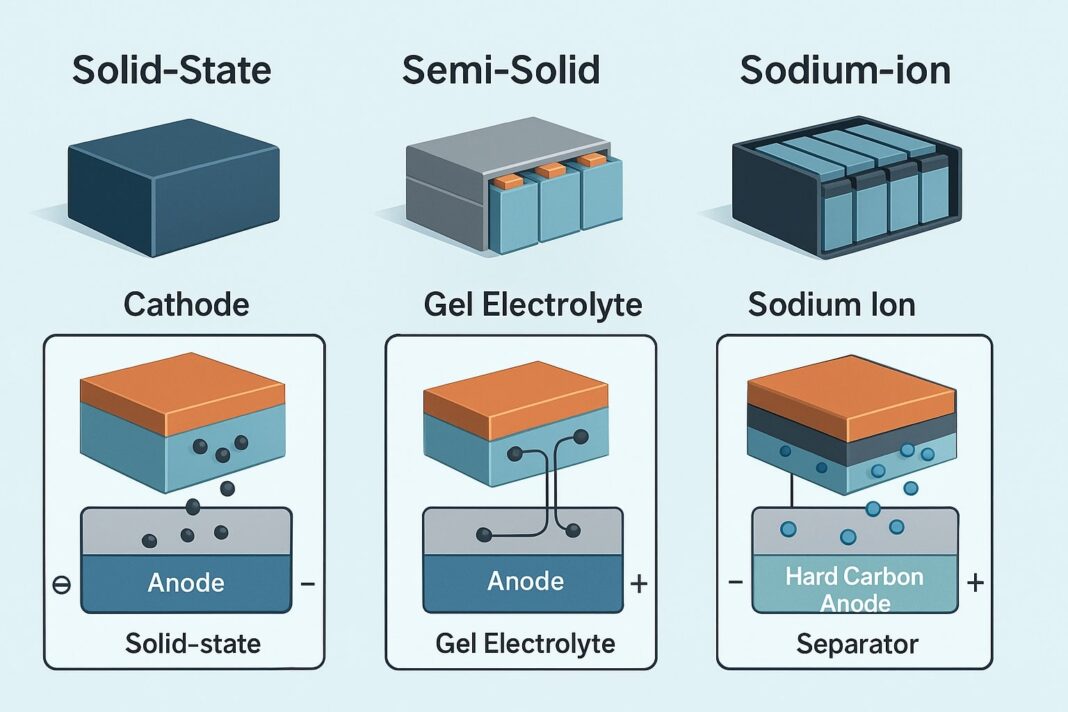
Solid-state batteries replace the liquid electrolyte with a solid electrolyte (ceramic, sulfide, or polymer).
Key Advantages
- Ultra-high energy density (400–800 Wh/kg possible)
- Extreme safety (no thermal runaway)
- Fast charging
- Longer lifespan
- Enables lithium-metal anodes → highest energy output
Challenges
- Very expensive to manufacture
- Difficult to produce at scale
- Sensitive to pressure and temperature
- Manufacturing defects reduce reliability
Ideal For
Premium EVs, aerospace, drones, performance vehicles, and long-range applications.
2026 Outlook
Toyota, BMW, QuantumScape, and Solid Power aim for early commercialization—but mainstream adoption may take until 2028–2030.
2. Semi-Solid Batteries: The Practical Bridge Technology
What They Are
Semi-solid batteries use a gel-like electrolyte—a hybrid between liquid and solid.
Key Advantages
- Higher energy density than lithium-ion
- Lower cost than pure solid-state
- Safer than liquid electrolytes
- Easier manufacturing (can use existing Li-ion factories)
- Better thermal stability
Challenges
- Not as energy-dense as true solid-state
- Still relies partly on liquid components
- Moderate charging speed
Ideal For
Mid-range EVs, energy storage systems, and early-stage solid-state transition markets.
2026 Outlook
Semi-solid batteries will be more widespread than solid-state by 2026 due to lower cost and simpler production.
Companies like CATL, ProLogium, and NIO are already deploying them.
3. Sodium-Ion Batteries: The Cost Champion
What They Are
Sodium-ion batteries replace lithium with sodium—an element far cheaper and more abundant.
Key Advantages
- Extremely low cost
- Uses no lithium, cobalt, or nickel
- Performs better in low temperatures
- Sustainable and easier to scale globally
- Ideal for grid storage
Challenges
- Lower energy density (120–180 Wh/kg)
- Heavier batteries
- Limited use for long-range EVs
- Not yet deployed in large-scale cars
Ideal For
Two-wheelers, small EVs, LFP replacement, home storage, grid storage, and renewable integration.
2026 Outlook
CATL, BYD, and Faradion are leading the charge.
Sodium-ion EVs may become common in India, China, and Europe for low-cost vehicles.
Head-to-Head Comparison
| Feature | Solid-State | Semi-Solid | Sodium-Ion |
|---|---|---|---|
| Energy Density | ⭐⭐⭐⭐⭐ | ⭐⭐⭐⭐ | ⭐⭐ |
| Safety | ⭐⭐⭐⭐⭐ | ⭐⭐⭐⭐ | ⭐⭐⭐ |
| Cost | ⭐ | ⭐⭐ | ⭐⭐⭐⭐⭐ |
| Scalability | ⭐⭐ | ⭐⭐⭐⭐ | ⭐⭐⭐⭐⭐ |
| Charging Speed | ⭐⭐⭐⭐⭐ | ⭐⭐⭐ | ⭐⭐ |
| Best For | Premium EVs | Mass EVs | Budget EVs & storage |
Which Technology Will Win?
Short-Term (2024–2027)
- Semi-solid will dominate mid-range EVs.
- Sodium-ion will rise in affordable EVs and energy storage.
Mid-Term (2027–2032)
-
Solid-state starts mass adoption in premium EVs & long-range cars.
Long-Term (2032–2040)
A hybrid ecosystem:
-
Solid-state = high-performance EVs
-
Semi-solid = mainstream EVs
-
Sodium-ion = budget EVs + massive grid storage
There is no single winner—each tech finds its own market segment.