

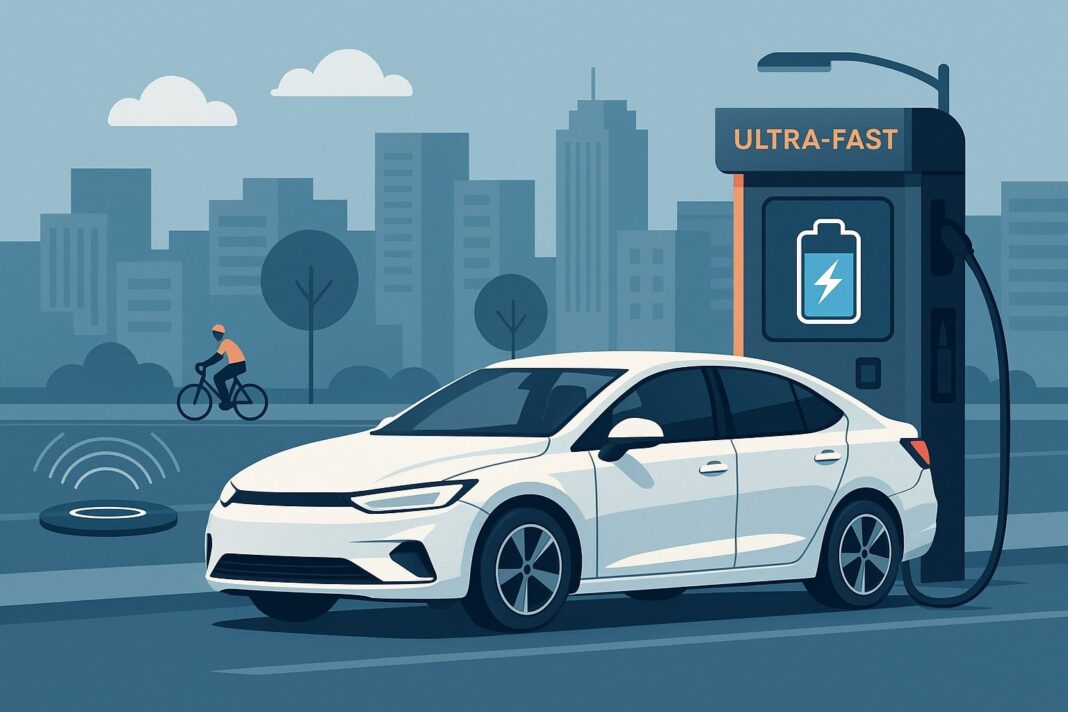
Urban mobility is changing faster than ever. As cities become more electrified, commuters demand charging that fits seamlessly into daily life — not something that slows them down. The future of EV charging isn’t just faster; it’s continuous, integrated, and invisible.
Ultra-fast chargers, wireless pads, and dynamic on-the-move charging systems are redefining how EVs stay powered in the heart of busy cities. This shift represents a new philosophy:
Charging should adapt to people — not the other way around.
1. Why Ultra-Fast Charging Is Essential for Urban Mobility
In cities like New York, Los Angeles, Chicago, and San Francisco, people travel short distances but require quick turnaround times. EV adoption is rising, but time and space are limited.
Ultra-fast charging solves:
-
Long charging wait times
-
Limited parking space
-
High-density urban traffic
-
Last-mile delivery downtime
-
Ride-share efficiency problems
A 150–350 kW charger can add 80–150 miles in 10–15 minutes, making charging feel like a normal gas-station stop.
2. The Rise of On-the-Move Charging Technologies
A. Dynamic Wireless Charging Roads
Cities like Detroit, Tel Aviv, and Oslo are piloting electric roads with coils buried under the surface that charge vehicles as they drive.
Benefits:
-
No need to stop
-
Perfect for buses, taxis, delivery fleets
-
Smaller batteries → cheaper EVs
-
Ideal for high-traffic corridors
B. Wireless Charging Pads at Intersections
Stoplights become charging zones.
Every 60–90 seconds of red light = additional range.
C. Bus & Fleet Fast-Charge Stations
Transit agencies now use:
-
450 kW+ overhead pantograph chargers
-
High-power depot hubs
-
Automated robotic connectors
This reduces downtime for public transit and logistics fleets.
3. Ultra-Fast Charging Networks Transforming U.S. Cities
A. NACS + Superchargers for All Automakers
Tesla’s NACS standard and growing Supercharger network will:
-
Improve reliability
-
Reduce queues
-
Give drivers predictable ultrafast access
B. NEVI-Funded 350 kW Stations
The federal NEVI program is building 30,000+ high-power chargers along highways and urban corridors.
C. Retail & Mall Charging Hubs
Shopping becomes charging time.
Major retailers adding ultra-fast chargers:
-
Walmart
-
Target
-
Starbucks
-
7-Eleven
-
Whole Foods
D. Ride-Share & Delivery Fleet Charging
Uber, Lyft, Amazon, UPS, and FedEx deploy dedicated fast-charge depots to keep vehicles moving.
4. On-the-Go Charging for Urban Commuters
A. Street-Level Pole Chargers
Existing streetlights are converted into EV chargers — no new construction required.
B. Curbside Fast Charging
Cities like New York and Los Angeles install 75–150 kW chargers at:
-
Curbsides
-
Public parking
-
Transit hubs
C. Autonomous Mobile Chargers
Robotic charging banks move to vehicles, not the other way around:
-
Perfect for parking lots
-
Makes charging “invisible”
-
Great for residential areas
5. How Ultra-Fast & On-the-Move Charging Boosts Urban Productivity
✔ No wasted time — charge while living
Charging blends into errands, work, dining, and commuting.
✔ Smaller EV batteries → lower costs
Dynamic charging reduces dependency on massive battery packs.
✔ Sustainable grid usage
Smart chargers shift load to off-peak or renewable energy windows.
✔ Delivery & ride-share efficiency
More trips per day → bigger revenue for drivers.
✔ Unlocks mass EV adoption
When charging is everywhere, confidence rises.
6. The Road to 2030: What’s Next for Urban Fast Charging
Expect:
-
EV charging roads in multiple U.S. states
-
Charging built into public transit routes
-
AI-optimized charging queues
-
Solar-powered micro-charging hubs
-
Smart curbs that charge AVs and robo-taxis
-
1,000 kW+ extreme fast charging (XFC)
-
Dynamic battery management for instant boosts
Cities will evolve into living energy networks that keep vehicles charged continuously.
Conclusion
The future of charging is fast, flexible, and frictionless. Ultra-fast chargers, dynamic charging roads, wireless pads, and mobile chargers create a world where EVs never really “run out.”