

The auto industry is undergoing a once-in-a-century transformation — not driven by engines or batteries, but by software. The modern car is no longer a mechanical machine; it’s a rolling computer, powered by an operating system that manages everything from infotainment to autonomous driving.
This has sparked the Automotive OS Wars — a battle between automakers, tech giants, chip companies, and software ecosystems to control the most valuable layer of the car: the software brain.
Who wins the Automotive OS war will control the future of mobility, data, revenue, and customer ownership.
1. What Is an Automotive Operating System (Auto-OS)?
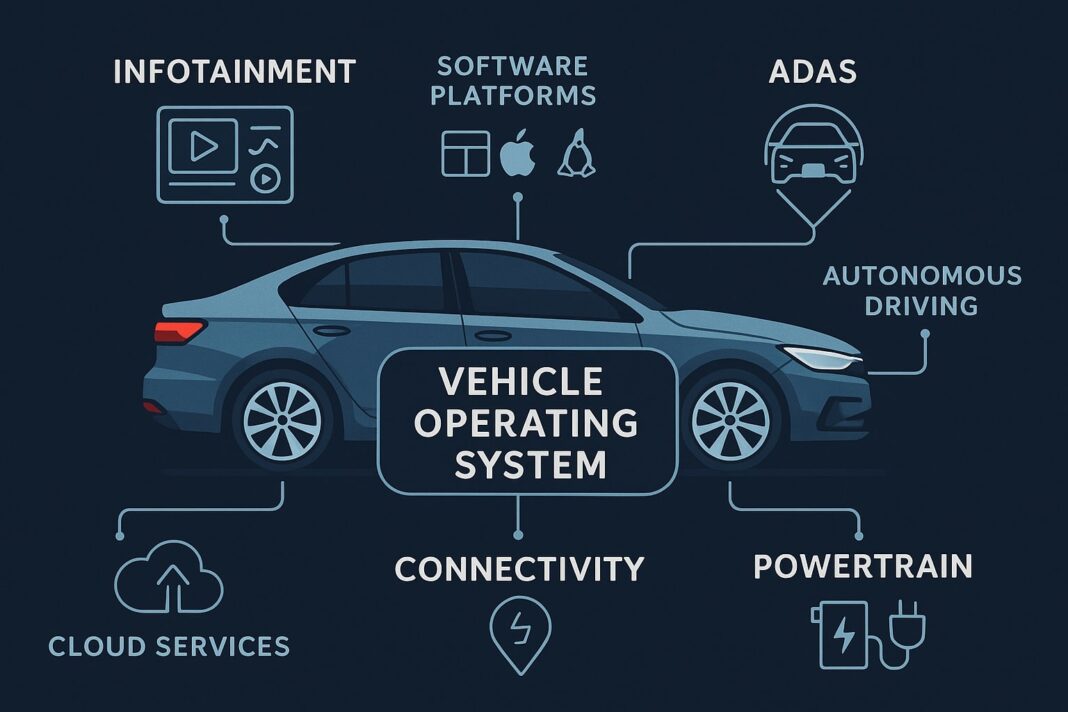
An Automotive OS is the core software layer that governs:
-
Infotainment
-
Advanced driver assistance (ADAS)
-
Navigation
-
Connectivity
-
Battery management (for EVs)
-
Safety systems
-
Over-the-air (OTA) updates
-
Autonomous features
It’s the “Android/iOS” equivalent for vehicles — and the company that owns it controls the entire in-car digital experience.
2. Why the OS Is the New Battleground
A. Software = Recurring Revenue
Carmakers can sell:
-
Navigation subscriptions
-
Autonomous driving upgrades
-
Smart features
-
Entertainment packages
-
Performance boosts
Software margins are 10× higher than hardware.
B. Data Is the New Oil
Connected cars generate 25 GB/hour of data.
Whoever controls the OS controls:
-
Driver behavior data
-
Battery + vehicle health data
-
Location info
-
Infotainment preferences
This data fuels AI, advertising, personalization, and predictive maintenance.
C. Autonomous Driving Depends on the OS
A single unified OS makes it possible to integrate:
-
Sensors
-
AI models
-
Cloud systems
-
V2X communication
Without a central OS platform, autonomy fails.
3. The Main Players in the Automotive OS War
1. Tesla — The Pioneer
-
Full in-house OS + UI
-
Controls everything from battery to autonomy
-
Fast OTA updates
-
Strong ecosystem lock-in
Strength: Vertical integration
Weakness: Closed ecosystem limits partnerships
2. Google — Android Automotive OS (AAOS)
Used by:
-
Volvo/Polestar
-
GM (earlier models)
-
Renault
-
Honda
Strength: App ecosystem (Maps, Assistant, Play Store)
Weakness: Automakers fear Google owning user data
3. Apple — Next-Gen CarPlay
Apple is turning CarPlay into a full vehicle interface:
-
Controls HVAC, clusters, navigation
-
Uses Apple UI and services
-
Deep brand loyalty
Strength: Seamless iPhone integration
Weakness: OEMs lose control of UX + data
4. Automaker-Owned OS Platforms
Mercedes MB.OS
-
Built on Nvidia DRIVE
-
Real-time 3D graphics
-
AI personalization
-
Level 3 autonomy-ready
BMW iDrive 9
-
Built on Android open-source
-
Custom UI
-
Focus on premium UX
Volkswagen CARIAD (in rebuild mode)
-
Trying to unify all VW brands
-
Software delays slowed rollout
GM Ultifi OS
-
Based on Linux
-
Deep integration with Super Cruise / Ultra Cruise
Strength: Full control
Weakness: Hard to match Silicon Valley speed
5. Chinese Tech Giants
Huawei, Baidu, Alibaba, Tencent
Leading globally in:
-
AI driving
-
In-car voice assistants
-
Connected services
China’s automotive OS market is the most advanced due to internal competition.
4. The Central Computing Revolution
Older cars use 70+ ECUs (small computers).
The future uses 1–3 central supercomputers powered by:
-
Qualcomm Snapdragon Ride
-
Nvidia DRIVE Orin / Thor
-
Intel Mobileye EyeQ
-
Tesla Dojo
This shift makes updates, AI, and sensor fusion possible.
5. Who Will Win? (2025–2035 Outlook)
Short-Term (2025–2027):
-
Android Automotive grows fastest
-
Apple expands CarPlay takeover
-
OEMs improve own OS platforms
Mid-Term (2027–2030):
-
Tesla, Mercedes, and BMW lead premium connected OS
-
Google dominates mid-range cars
-
Chinese OS platforms expand globally
Long-Term (2030–2035):
The market consolidates into 4 major OS ecosystems:
-
Tesla OS
-
Android Automotive OS
-
Apple Car OS
-
OEM Unified Platforms (MB.OS, iDrive, Ultifi, etc.)
Who wins depends on:
-
App ecosystems
-
Partner networks
-
Hardware integration
-
Data ownership
-
Autonomous driving performance
6. What the Automotive OS War Means for Consumers
✔ More personalized cars
✔ Always-improving OTA updates
✔ Better maps, entertainment, and navigation
✔ Smart diagnostics
✔ Software upgrades instead of new car purchases
But also:
❗ Increased data collection
❗ Proprietary ecosystems
❗ Higher subscription dependency
The future car will feel more like a smartphone on wheels — with all the benefits and trade-offs.