

As EV adoption accelerates globally, battery safety has become the most critical engineering challenge. One of the biggest risks is thermal runaway — a dangerous chain reaction where a battery cell overheats, releasing energy uncontrollably. This can spread rapidly to other cells, causing fires or explosions.
But the EV industry is entering a new era. Major automakers and battery innovators are developing next-generation thermal-runaway prevention technologies that make EVs safer than ever before.
This article explores the cutting-edge systems that will define EV safety from 2025 to 2030.
1. What Is Thermal Runaway — And Why It Happens
Thermal runaway occurs when a battery cell experiences:
- Internal short circuit
- Mechanical damage
- Overcharging
- High external heat
- Manufacturing defects
Once the cell temperature exceeds 120–150°C, internal materials break down and release more heat — triggering a chain reaction.
Stopping that chain reaction is the core objective of modern EV safety innovation.
2. The New Technologies Preventing Thermal Runaway
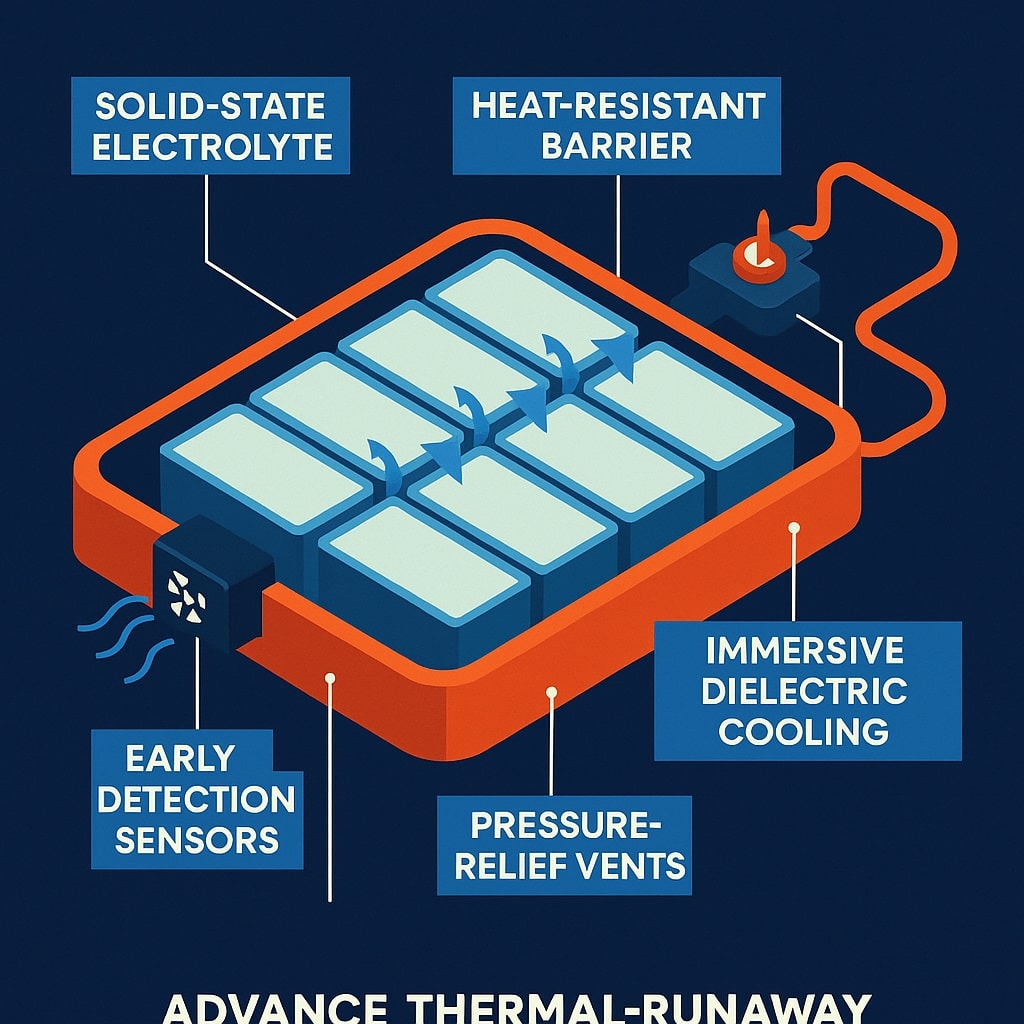
A. Solid-State Electrolytes: No Flammable Liquids
Traditional lithium-ion batteries use a flammable liquid electrolyte.
Solid-state batteries replace this with non-flammable solid electrolytes, making the battery:
- Far more stable
- Resistant to punctures
- Nearly incapable of thermal runaway
Companies like Toyota, QuantumScape, and Samsung are leading this breakthrough.
B. Cell-to-Pack Firewalls & Thermal Barriers
Modern EVs now include:
- Ceramic-coated separators
- Heat-resistant cell partitions
- Microlayer fire-retardant coatings
- Expansion foam between cells
These barriers isolate each cell, stopping heat propagation across the battery pack.
C. Immersive Dielectric Cooling (Immersion Cooling)
Instead of using air or coolant tubes, the entire battery pack is immersed in a non-conductive cooling liquid.
This ensures:
- Ultra-fast heat dissipation
- Zero hotspots
- Controlled temperature across all cells
Leading companies: XING Mobility, MIVOLT, CATL (Qilin Pack).
D. Early Detection Sensors: AI + Real-Time Monitoring
Smart BMS (Battery Management Systems) now include:
- Gas sensors detecting electrolyte vapors
- Microtemperature sensors inside each cell
- Pressure sensors identifying swelling
- AI models predicting cell failure
These systems detect abnormalities milliseconds before they turn dangerous.
E. Pressure-Relief & Venting Systems
In case of severe internal heat, EVs now feature:
- Venting channels redirecting gases away
- Anti-explosion plates
- Multi-layer aluminum-ceramic shielding
The goal: release pressure without allowing fire to escape.
F. Fire-Resistant Battery Pack Architecture
New EVs use:
- Structural battery packs with reinforced steel frames
- Heat-insulating foams
- Fireproof lids and enclosures
- High-temperature aerospace-grade materials
These designs contain thermal events long enough for safe evacuation.
3. How Automakers Are Reinventing Battery Safety
Tesla
-
Introduced “firewalled cell architectures”
-
Built thermal runaway-resistant 4680 cells
BYD Blade Battery
-
LFP chemistry
-
Nail-penetration safe
-
Zero thermal runaway in tests
CATL Qilin Pack
-
13% temperature reduction
-
Multi-layer structural cooling
Mercedes Benz (EQS)
-
Multiple sensor redundancy
-
High-tech cooling channels in each module
GM Ultium Platform
-
Nickel-rich chemistry with advanced protection layers
-
Wireless battery management
The entire automotive ecosystem is prioritizing heat safety like never before.
4. Why 2026–2030 Will See a Big Safety Leap
- Solid-state commercialization begins
- AI-based predictive BMS becomes standard
- New regulations require built-in runaway containment
- Immersion cooling becomes mainstream
- EV packs become modular & fail-safe
EVs are projected to become safer than fuel cars by 2030.
5. The Future: Zero-Runaway Battery Systems
Over the next decade, expect:
- Fully non-flammable electrolytes
- Self-healing battery materials
- Graphene-based thermal channels
- Built-in nanocoatings that block oxygen
- Autonomous cooling responses using AI
The ultimate goal: batteries that physically cannot enter thermal runaway.
Conclusion
The next frontier in EV safety is already here.
From solid-state chemistry to AI thermal prediction and immersion cooling, EV manufacturers are deploying multiple layers of protection — making modern electric vehicles among the safest machines on the road.